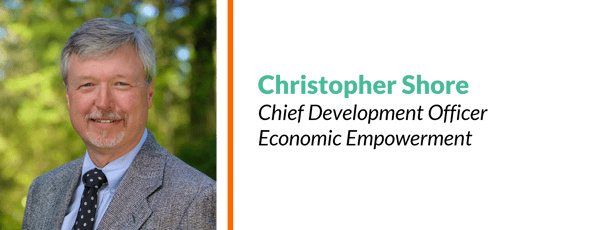
Every once in a while, life gives you a “teachable moment”. As a parent I learned to be always on the lookout for them, as a “teachable moment” allows important lessons to be better and more quickly learned.
The recent publication by the Wall Street Journal of an article critical of microfinance has created a teachable moment about the role, importance, and limitations of microfinance in the strategy of ending extreme poverty. And this teachable moment is perfectly timed, as this is the time in the year when we focus the newsletter on our microfinance work. More on that later in the newsletter.
Microfinance, or the provision of financial services to those living in extreme poverty, is all through the THRIVE program. It pops up first in savings groups, which is where people learn to save money together. Savings is a critically important financial asset, being the best tool for dealing with unexpected shocks like an illness, accident, or crop failure. However, the main motivation to join a savings group is usually to also get a loan from the group to start or improve a farm or business. Credit is the second important financial asset, and it comes from savings groups and from FAST loans. The third financial asset that helps us build improved and resilient livelihoods is insurance. VisionFund International, our microfinance subsidiary, has been doing insurance for over 20 years, and we have learned that low cost health insurance provides a critical buffer for poor families facing illness. We are also learning how to offer other types of insurance products.
You might notice that I just mentioned FAST. FAST is actually an acronym, Finance Accelerating Savings Group Transformation. With savings groups being the foundational economic intervention of THRIVE, we want to see savings group members move out of extreme poverty quickly and stay out of extreme poverty for good.
In THRIVE we harness microfinance — savings, credit, and insurance — for good!
A teachable moment about microfinance and ending extreme poverty
On June 10th the Wall Street Journal published an article about microfinance with the headline, “Hundreds of Billions in Loans Didn’t Make a Dent in Global Poverty”. The article makes two main arguments and infers a third point. Let’s review the arguments carefully.
First, the article laments that providing financial services to the poor has proven to not be a “silver bullet” that solves the problem of poverty. There is an important question to ask here: ‘Why would any experienced business professional or economist assume that it would?’
A quick review of World Bank publications about extreme poverty shows that the vast majority of the people living in extreme poverty today are self-employed. That is, they are running their own small business or farm. To lift themselves out of extreme poverty means they need to earn a lot more money. To do that, they need to grow and improve their farm or business.
So, let’s ask an important question: What is the one, single thing that any business owner anywhere needs to do in order to always improve the business and make more money?
Sorry, but there is no one, single, solitary thing! Whether you are running General Motors or Google, or a neighborhood taco stand, there is no one, single thing that you always need to grow and improve your business. Do you need access to finance? Often yes, but you also need to access markets in the right way and at the right time. You need the right tools and technology, the right skills and know-how, and the right information about what is happening in the marketplace and with your customers.
For over 25 years, World Vision has been working to ensure that the people we serve have access to the suite of tools they need to lift themselves out of extreme poverty. Since 2011, we have used an approach we call THRIVE. THRIVE uses many of the tools you might expect:
We help people who are already farming move from subsistence farming to become small commercial producers, helping them be both more productive and more profitable.
For those who are just beginning their economic journey, we have found that the optimal place to start is to encourage them to join a savings group; here they learn to save money together, then lend to each other from their own funds to start a business or take advantage of an economic opportunity. The savings group offers business coaching and encouragement and operates like a small business incubator as members are always sharing and debating new business ideas and opportunities.
We use microfinance loans, predominantly to mature savings groups early in their annual cycle, so that they have more money for lending earlier, can smooth out their capital availability, and ensure that more of their members get a bigger loan faster.
Surprisingly for some, we have found that the most important step, and where we always begin with THRIVE, is addressing the worldview issues of the participants, with a primary focus on their identity and agency. We call our approach the Biblical Empowered Worldview curriculum.
External analysts have evaluated our work and determined that every $1.00 invested in THRIVE results in $6.67 in economic benefit to the people we serve. It’s working!
Second, the article rightly calls out that unbridled for-profit microfinance lenders in over-saturated markets, pursuing profits only and not thinking hard about the needs and vulnerability of their clients, can cause great problems for the poor. Good point. World Vision strongly agrees with the author’s observations and concerns. That abuse is good reason for lament.
That is also why World Vision’s mission-driven microfinance ministry — VisionFund International — is continuously moving from urban to rural loans, from easy to reach geographies to hardest to reach areas, and from ever larger loans to ever smaller loans — now down to “nano-finance” through our program of FAST loans to savings groups. We aim to serve the people who most need access to financial services as a tool to lift themselves out of extreme poverty.
Third, and finally, the Wall Street Journal article’s headline about global poverty might need some edits. It infers that there has not been a dent made in global extreme poverty. In 1990, about 43% of the world’s population lived in extreme poverty. Today, it is about 10%, a reduction of more than 75%. What made the dent in global poverty? Is there a connection with microfinance loans? Something else?
Now THAT is a story well worth digging into!
FAST: expanding opportunity through savings, technology, and reslience
Almost 15 years ago, we observed that people living in extreme poverty were moving upwards economically as they participated in savings groups. We wondered whether we could accelerate that process, and began experimenting with lending, not to the members but to the savings group itself. In our experiments we made every mistake imaginable but learned how to lend to mature savings groups without getting them over-leveraged. We call this program of lending to savings groups FAST (Finance Accelerating Savings Group Transformation) loans.
The FAST program continues to grow rapidly. As of April 2026, nearly 25,000 savings groups were actively participating, a 46% increase compared to the previous year. The outstanding loan portfolio has also nearly doubled, growing from $8.4 million to $16 million, demonstrating strong demand for financial services among savings group members. In THRIVE-supported locations alone, more than 84,000 members have been reached this year, with $3.8 million in loans disbursed to support household and business growth.
FAST is also evolving beyond simple loans, and beyond simply loans. FAST is building on the innovations of the DreamSave platform savings groups are using to improve our services. To encourage the use of the DreamSave app, a pilot “phone loan” product provides small, zero-percent loans, that help groups purchase smartphones and begin their digital journey. Once groups are using DreamSave, loan eligibility can be assessed more quickly, reducing turnaround times and improving quicker access to new loans.
In several countries, health and hospital insurance have been integrated into the FAST program, helping families build greater financial security. This is a quickly expanding part of our work. Currently, VisionFund added 650,000 people under an insurance umbrella, an increase of 66% in 12 months (we do not underwrite the insurance ourselves, but we have learned to be excellent insurance brokers). We are expecting massive growth this year by partnering with other groups as well as expanding beyond health and hospital insurance. We expect to help 3.8 million people across 30 countries this year.
Looking ahead, VisionFund is preparing communities for the impacts of the El Niño event — droughts, floods, and powerful storms. New disaster preparedness training materials is equipping loan officers to help savings groups build their resilience by planning for the expected El Niño impacts. We are looking to quickly recapitalize savings groups impacted by disasters through Recovery Lending for Resilience programming.
Through FAST, families are gaining access not only to financial services, but also to the tools, knowledge, and resilience they need to thrive.
Praise God for the strong impact of savings groups, FAST loans, and microinsurance in the lives of people around the world.
Pray for wisdom and guidance for World Vision and our microfinance partner, VisionFund, as we prepare for the impacts of the El Niño event on vulnerable communities around the world.
Thank you for uniting with us in prayer and for your faithful partnership!
Receive the newsletter: If you do not yet subscribe to this newsletter or you'd like to share this with others so that they may receive these newsletters, click the button below.